On the drier side of the grassland biome lies the steppe
grasslands. Vegetation must cope with the summer soil moisture deficit
common to the steppe
climate
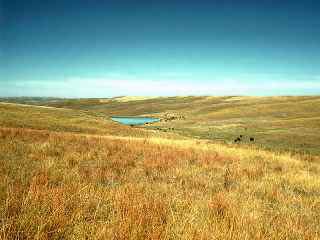
in which this formation class is found. Here, tall grass prairie gives way to grasses
smaller than a half meter (2 ft).
Figure 13.21 Mixed Tall and Short grass
prairie of the U.S. Great Plains.
(Courtesy NRCS)
Toward the drier portions the ground cover becomes
sparse with patches of open ground found between clumps of grass. Overgrazing of the
steppe vegetation leads to accelerated wind erosion and desertification.
Fires,
especially those started by lightning, are a natural occurrence in the
grassland biome. Fire destroys invasive species that compete with
grasses. Fire suppression and farmland conversion have severely
disrupted grassland ecosystems. Resource mangers now use prescribed
burning to restore the health of prairie grasslands.
The
Kalahari Desert actually isn't a desert under present conditions,
though it is covered with much sand. It is a fossil desert found in the
tropical steppe biome. Parts receive over 250 mm of precipitation,
enough to support a cover of vegetation. It is a fossil desert found in
the steppe biome. It' name is derived from the tribal word Khalagari,
Kgalagadi or Kalagare meaning "a waterless place" or the Tswana word
Keir, meaning "the great thirst".
Video: "Struggle" from Kalahari:The Great Thirstland
(Source: Nature - PBS)
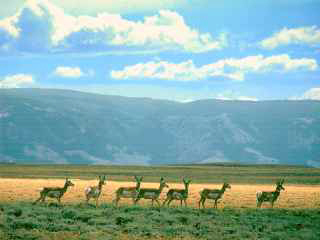
Figure 13.22 Wild
Pronghorn Antelope cross the short grass prairie of Wyoming. (Courtesy NRCS)
Burrowing animals like ground squirrels, prairie dogs, pocket gophers are
common in the steppe grasslands of North America. Burrowing predators like the black footed ferret are
considered an endangered species.
Watch: " National Bison Range Wildlife Refuge - near Missoula, Montana, MT."